If paper discovery is about conquering large volumes of documents, electronic discovery (E-Discovery) is about overcoming the complexity of a diverse digital ecosystem.
Digital evidence is everywhere. Emails, texts, collaboration platforms, cloud storage, mobile devices, application data. Every interaction leaves digital fingerprints. But unlike paper, it is not just sitting in one place. It is distributed, encrypted, and constantly changing.
Too many legal teams treat E-Discovery as a collection exercise, like a game of 2D chess where moves are sequential, limited, and reactive. Identify sources, pull data, review what comes in. But that mindset breaks down quickly. Access barriers, fragmented systems, and sheer data variety slow everything down. Critical evidence is missed or delayed, and timelines slip.
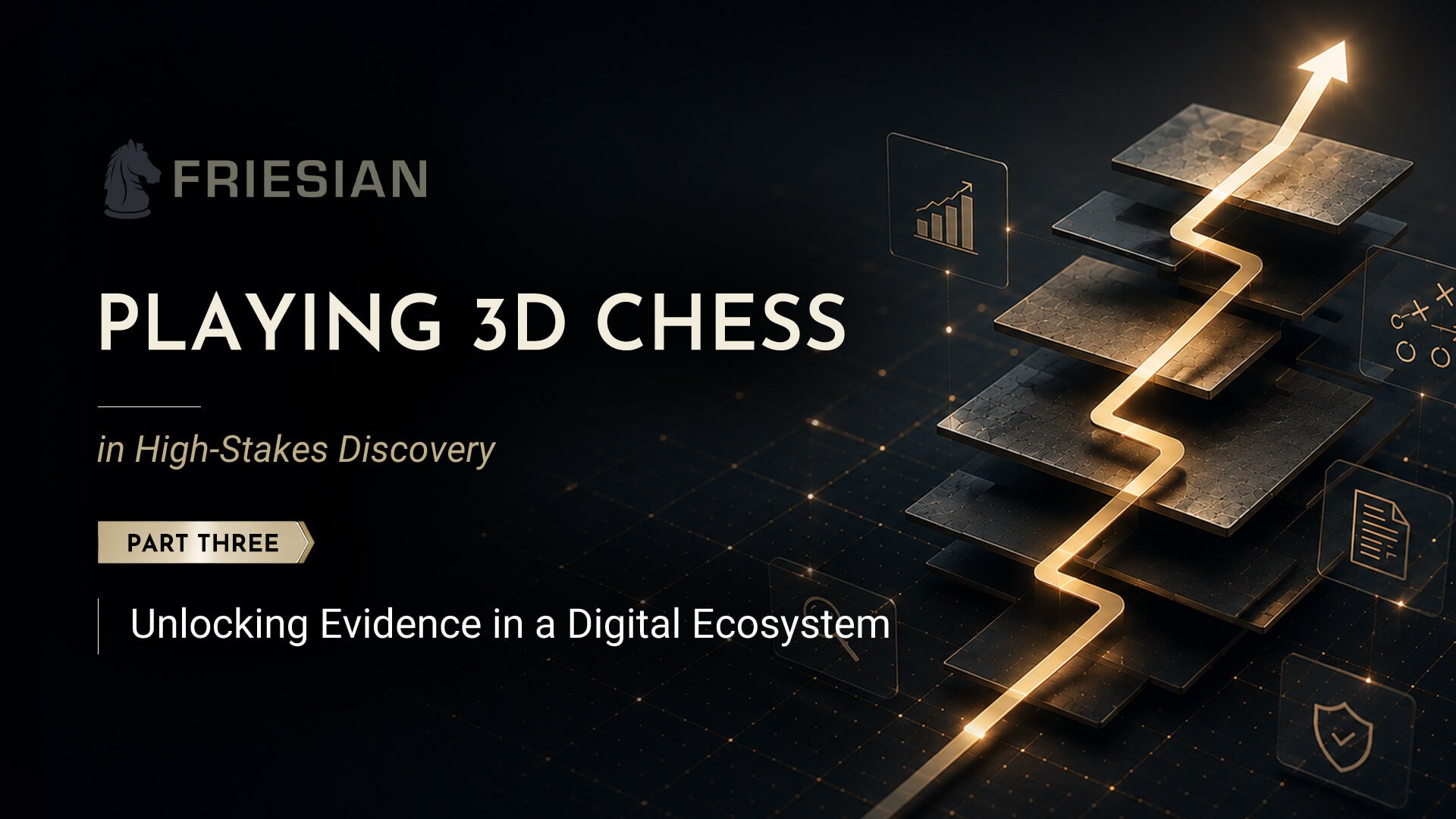
Teams who can play multidimensional, 3D chess while their opposition is confined to a flat board will start E-Discovery earlier and go deeper. It is not just about collecting data, but rather unlocking it, preserving it, and understanding how it fits together before the opposition can build their narrative.
But devices and accounts are protected by passwords, encryption, and multi-factor authentication. Data may be spread across personal devices, enterprise systems, and third-party platforms. Each source requires a different method of access and preservation, and every step must be defensible. That requires a level of technical acumen that legal teams rarely have on staff.
Friesian brings that technical acumen to legal teams. Using proven digital forensics techniques, data is securely accessed, collected, and preserved from a wide range of sources, from mobile devices and computers to cloud-based systems and online accounts. The process is documented end to end, ensuring evidentiary integrity and admissibility .
Chain of custody is just as critical here as it is with paper, but more complex. Every action taken on a device or dataset must be tracked, including how it was accessed, when it was collected, and what was preserved. Without that level of rigor, digital evidence can be challenged, even if it is highly relevant. In high-stakes matters, that risk is not acceptable.
Friesian embeds that rigor into the process. Collection, preservation, and analysis are handled in a way that maintains a clear, defensible chain of custody across every digital source. That discipline ensures the data stands up under scrutiny, not just in review, but in court.
While others are still trying to access data, you already have it preserved and structured. While they are piecing together fragments, you are analyzing patterns and timelines. While they are reacting to what they find, you are shaping the direction of discovery. You’re playing 3D chess while others are still making limited, linear moves.
Teams that treat E-Discovery as a back-office function fall behind. Teams that partner with the right digital forensics expert can approach it as a coordinated, multidimensional strategy, moving faster, uncovering more, and controlling the pace of the case.
In the final post, we will look at what ties it all together: the processing, coding, and indexing that turn raw evidence into usable insight. Stay tuned and please reach out with any questions.